
The Ultimate Curveball

Elmhurst vintage baseball game uses historic rules in annual city vs. university matchup
At its founding, America’s favorite pastime looked quite different from the modern game fans know and love today. Baseball has captivated audiences since the 1840s—even though its early iterations followed a very different set of rules.
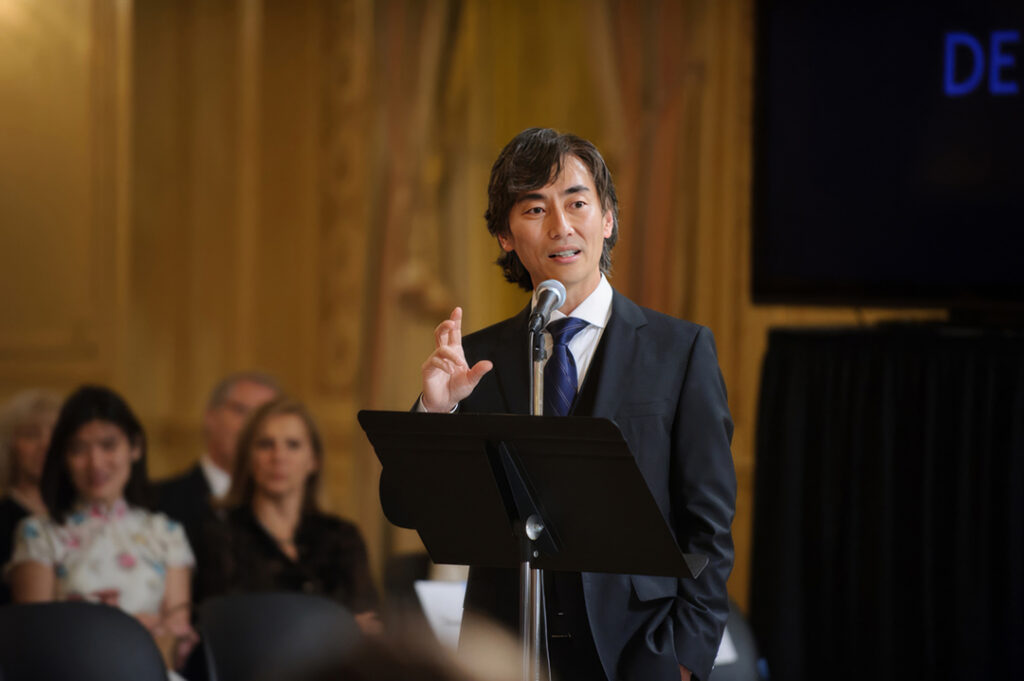
Elmhurst Historical Museum director Dave Oberg became hooked on the game’s roots while working at a living history site that featured a vintage baseball team. His fascination with the 1858 rules and tradition led him to start his version of a vintage game right here in Elmhurst: the annual Town vs. Gown game.
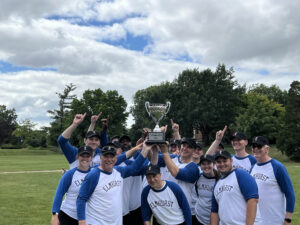
The City of Elmhurst and Elmhurst University vie for the coveted Cottage Hill Cup every year.
“I had brought vintage baseball to every single community I’d ever worked in, because it’s just a lot of fun,” Oberg said. “It’s one thing to lecture about the history of baseball. It’s another thing to see it actually played and played by roles that are a lot different than what you and I are used to today. But you kind of squint and you say, ‘Oh yeah, I kind of recognize this game.’”
The annual contest is a lively mix of interactive history and a bit of friendly competition between the City of Elmhurst and Elmhurst University, whose teams vie for the coveted Cottage Hill Cup. Oberg serves as the umpire, explaining the rules to fans in the stands as the action unfolds.
“Typically, the university president and the Mayor of the City of Elmhurst serve as the captains of this team, and we just got a whole cavalcade of wonderful people who play. It’s just a blast,” Oberg said.
This annual event has grown in popularity since its start in 2019, and the returning team members have become experts at the Knickerbocker Rules:
“It’s a bare-handed game. There are no gloves. The pitching is done underhanded…and the pitcher is really there more to put the ball in play,” Oberg explained. “It is still three strikes and you’re out. But because the pitching is done underhanded, it’s not fast pitch, and it’s only a strike if you swing and miss. It’s very rare to see somebody actually struck out, and that makes for a higher scoring game.”
“It is one of my absolute favorite days of the year.”
– Dave Oberg, Elmhurst History Museum director
As the sport evolved, these parameters were not sufficient for the developing skill sets of the professional players. Pitchers experimented with throwing faster pitches, and they soon became a deciding factor in the game’s outcome. As the sport grew in popularity, changes were needed to accommodate the rising expectations of fans.
“The more we play, the more it becomes a huge spectator sport, too. People want to see, you know, great showmanship and great games and what have you,” Oberg said. “So, we start tightening the rules more and more.”
“You know, throwing 20 pitches underhanded to somebody, and them refusing to swing at any of them until they see the right ball, the game would go on all day,” Oberg continued. “So, we start calling strikes. We start calling balls. We go to overhanded pitching by 1882, you know, as the ball becomes smaller, tighter, it gets hit a lot faster. We need gloves all of a sudden.”
Much like baseball’s rapid spread from East Coast fun to a national phenomenon, the Town vs. Gown game has become a beloved Elmhurst tradition. This year’s game will be held on September 28, so students will be back on campus to cheer on their team in what is often a very close and spirited game. Watching their professors at bat in a vintage-inspired uniform is expected to be a major hit.
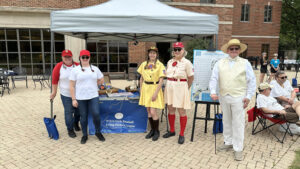
The WWII Girls Baseball Living History League with EHM Executive Director Dave Oberg
“I do teach the audience a lot of the old-fashioned Victorian slang as part of the game, too. I teach them old-fashioned cheers. We have fight songs for both teams,” Oberg said. “It’s just an absolutely great time. Honestly, it is one of my absolute favorite days of the year.”
This year’s Town vs. Gown game will be played on September 28 at 2 PM. It is free to all attendees. To learn more, visit events.elmhurst.edu. ν